kage
kage
opensend.cc
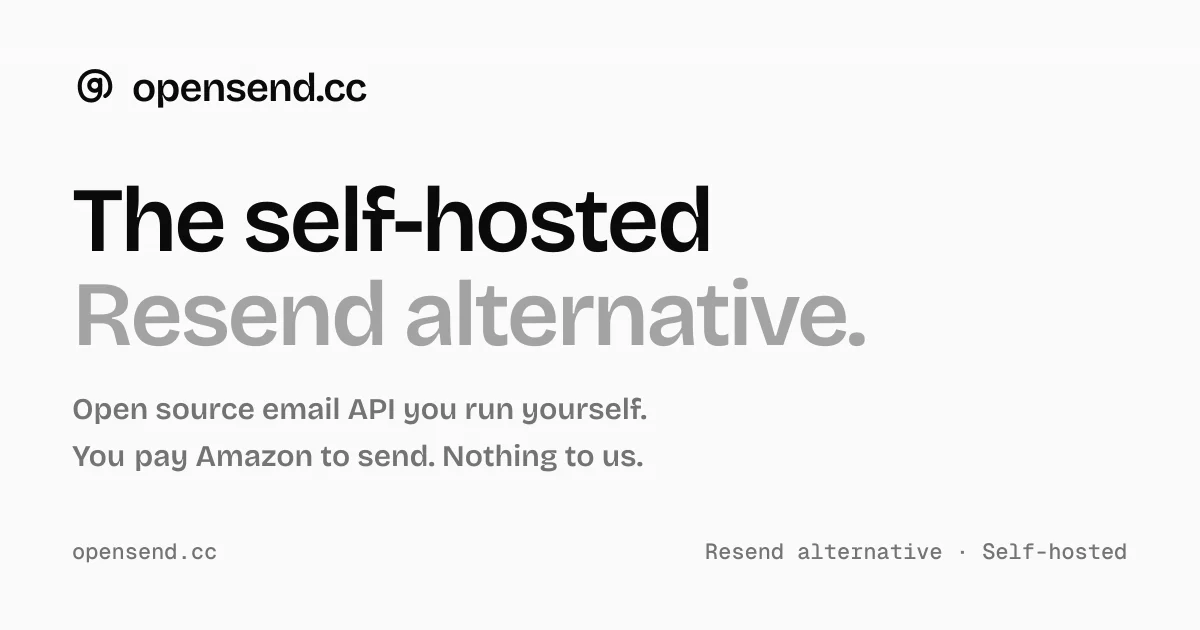
Design analysis
A purely typographic 1200×630 card with no illustration or product screenshot — the composition leans entirely on type scale and colour contrast. All content hugs a single left margin on a warm off-white canvas: a small circular glyph plus wordmark at top, a two-line display headline where the first line is solid black and the second drops to light grey for emphasis-by-deemphasis, a two-line supporting sentence, and a monospace footer row that spans left-to-right with domain on one side and category tags on the other. The rhythm is one tall block of text with generous negative space above and below, and the mono footer gives the card a technical, open-source framing.
Prompt preview
## Reference images

Study these alongside the description below: hierarchy, rhythm, spacing, colour. Build for the product you are asked about, using this design language.

- Screenshot: https://kage-design-assets.t3.tigrisfiles.io/screenshots/opensend-cc/d9b6436b-f252-481a-8184-2aca1ba4a4a7-1791180113458.webp
- Design on Kage: https://kage.design/designs/opensend-og-image

## Before you start
Ask the user what product the social card is for, who it is for, and what brand assets they already have (name, domain, colours, typefaces). Wait for the answers before designing — everything below is applied to their brand, not to the reference product.

## Deliverable
Produce a single **1200×630** Open Graph social card image, for example as an HTML/CSS file sized exactly 1200×630 rendered to PNG (e.g. with a headless browser or Satori/Resvg), or as an SVG. Use placeholder branding and copy from the user's answers. No interactivity needed — it is a static image.

## Canvas structure (top to bottom)
- **Canvas**: one flat, warm off-white field (approx `#F4F2ED`), no gradients, no imagery, no borders. All content sits inside a generous left margin (~80px) and is left-aligned on a single invisible column.
- **Top row (identity)**: at the top-left, a small circular monogram glyph (~36px) followed by the brand name in bold black, sized around 32–36px. This is the smallest